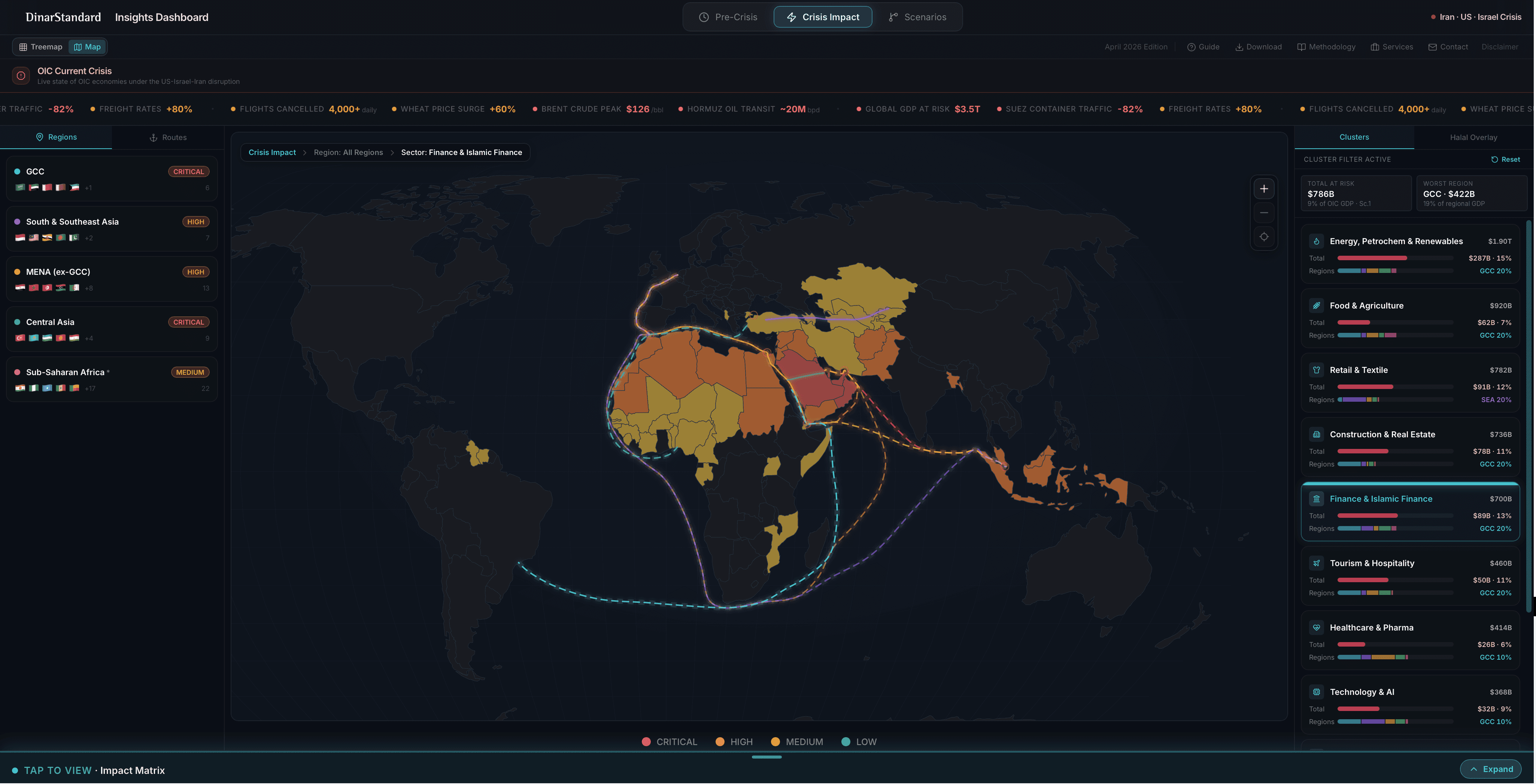
The US–Israel–Iran regional crisis has disrupted some of the world’s busiest air connections. Airspace closures, higher aviation costs and concern about safety have affected airlines first, then hotels, events and travel companies across the Organisation of Islamic Cooperation (OIC). Yet the impact varies sharply by destination and type of trip.
DinarStandard’s October 2026 Travel & Tourism Outlook for OIC Countries examines the sector’s position before the crisis, the evidence available through early October and the strategic choices facing governments and businesses. Its planning case is a protracted war, with a growing risk of wider regional escalation.
What the Insights Brief Covers
The crisis scenarios and the channels through which disruption reaches travel and tourism
A 2025 baseline for selected OIC destinations and same-period 2026 visitor trends
The impact on aviation, accommodation, events and travel services
Differences across regions and between leisure, business, domestic and religious travel
Seven strategic options for the next one to five years
From Record Growth to an Uneven Recovery
Many OIC destinations entered 2026 with strong momentum. Dubai and Morocco recorded historic visitor numbers in 2025, while Uzbekistan posted double-digit growth. The sharpest reversals in 2026 have been at the GCC’s international hubs.
Dubai welcomed 6.97 million international overnight visitors in January–August 2026, 44% fewer than in the same months of 2025. Qatar’s visitor numbers fell 30% over the same period. Saudi Arabia’s inbound tourists declined 13% in the first quarter, but domestic tourists increased 16%, helping limit the drop in total tourism spending to 2%.
Airline capacity has recovered faster than passenger traffic. For international flights operated by Middle Eastern carriers, August 2026 capacity was 9% below a year earlier, while traffic was 14% lower. About 79% of seats were filled, compared with 84% in August 2025. Restoring capacity alone has therefore not restored the region’s former traffic volumes.
The losses extend beyond airlines. Fewer arrivals reduce hotel occupancy and room rates, while cancelled or postponed events remove high-spending visitors. Travel agents and tour operators must manage cancellations and changed routes. The brief finds the most severe exposure among GCC hub airlines, hub airports, hotels serving international visitors and major events. Businesses serving domestic travelers have generally had a stronger cushion.
Different Markets, Different Travel Patterns
Several destinations outside the GCC continued to grow. Visitor numbers rose 21% in Uzbekistan and about 5% in Indonesia in January–August 2026. Morocco grew 5% in January–September, and Egypt grew 4% in January–August. Türkiye and Jordan were about 2% below their comparable 2025 levels, while Malaysia was broadly flat at 2% above 2025.
Those gains should not be read as proof that tourists switched from GCC destinations. Uzbekistan’s increase came largely from neighboring countries, and Indonesia’s growth was led by visitors from Malaysia. Source-market data are too limited to establish how much travel, if any, was diverted by the crisis.
Travel purpose also matters. Saudi domestic tourism rose as inbound tourism fell. Religious travel presents a more mixed picture: external Umrah performers declined 12% in the first quarter of 2026 compared with a year earlier, while internal performers increased 9%. The total was nearly flat. GASTAT’s internal category includes non-Saudi residents of the Kingdom. Because the quarter includes January and February, before the war began, the full change cannot be attributed to the conflict. Business travel and trips connecting through affected hubs faced greater disruption. The central challenge for destinations is therefore broader than replacing lost seats: travelers also need reliable routes, affordable fares and confidence that they can complete a trip.
Strategic Priorities for OIC Travel and Tourism
The brief identifies seven options, with different priorities for each region:
Build air-network and cost resilience through agreed diversion routes, backup capacity and stronger financial planning.
Develop domestic and regional demand where resident markets can support hotels and attractions through an inbound downturn.
Broaden source markets and travel segments to reduce dependence on a small number of routes or visitor groups.
Establish crisis information and confidence monitoring so travelers and operators can find current advice, schedules and service updates in one place, while destinations track perceptions and bookings.
Strengthen traveler and pilgrim protection with clearer rebooking, refund and visa-extension arrangements.
Pilot multi-destination tourism corridors that can expand choices for visitors over time.
Share tourism data and early-warning signals across OIC markets to detect changes in air capacity, bookings and visitor demand sooner.
For the GCC, the immediate emphasis is on air access, broader source markets, traveler protection and rebuilding confidence. In South and Southeast Asia, domestic demand and pilgrim services merit attention. North Africa, the Levant and Central Asia have different opportunities to diversify source markets and develop joint itineraries.
Planning for a Longer Disruption
The available data point to a recovery that differs by route, market and purpose. GCC hubs have regained some capacity, but passenger traffic still trails it. Stronger results elsewhere show that OIC travel is not moving as a single market. They do not establish that those destinations are benefiting from displaced GCC travel.
Under a protracted-war scenario, the most useful investments are capabilities that work during the next disruption as well as this one: alternative air connections, dependable traveler information, clear protection rules and timely shared data. These measures can help governments and businesses protect demand while building a more resilient tourism sector.
Methodology note: Visitor changes compare each destination with the same months of 2025. Reporting periods and visitor definitions vary across countries, so the percentages describe changes within each market rather than a directly comparable OIC-wide total. The brief’s strategic priorities are DinarStandard judgments based on the evidence reviewed through early October 2026.