The February 2026 US-Israel-Iran regional crisis has exposed Food & Agriculture as the OIC's most structurally vulnerable non-energy cluster. With $302B in annual imports and 72.2% of supply sourced from non-OIC countries, the bloc faces disruption through two distinct channels — and the impacts will persist well beyond any ceasefire. Building on the April 2026 edition that mapped the macro crisis across 11 OIC industry clusters, DinarStandard's May 2026 Insights Brief turns to Food & Agriculture — the largest non-energy halal-economy cluster — examining its exposure to both Direct and Domino disruption across OIC markets.
What the brief covers
The brief provides:
A sector profile of the OIC food and agriculture cluster: $302B in 2024 imports, 17.7% of global food trade
Analysis of Direct impacts (Hormuz routing, Iran-origin trade, halal channels) and Domino impacts (fertilizer feedstocks, producer-country exposure)
A ranked impact matrix across 23 food categories — Cereals, Meat & Offal, and Animal Feed as the most acute
A May 2026 pulse check on trajectory, with Brent at $103–117/bbl and talks still stalled
Eight strategic positioning options for OIC governments and corporates over the next 1–5 years
Regional strategic themes across the GCC, MENA, South & Southeast Asia, and Sub-Saharan Africa
Why this matters
Food & Agriculture is the OIC's largest non-energy import dependency — and unlike energy, the bloc is a net importer. With 28 Low-Income Food Deficit nations, a $110B food import gap, and the top three external suppliers all reliant on Gulf-origin fertilizer inputs, the exposure is both immediate and structural. Through the Domino channel, input disruptions today are shaping the 2027–29 agricultural outlook.
Key findings
Sector scale — OIC food imports reached $302B in 2024, contributing $920B in value-added, the second-largest industry cluster at 10% of OIC GDP. Intra-OIC supply has grown to $83.3B (27.8% OIC self-supply), but 72.2% remains externally sourced, from non-OIC countries.
Two impact channels — Direct impacts arrive in weeks: Hormuz routing disruptions, Iran's export ban on pistachios, saffron and dates, and halal channel blockages. Domino impacts arrive in months but persist for years: Gulf urea shortages are idling Indian and Pakistani fertilizer plants, and sulphur scarcity is halving Morocco's DAP output.
Top exposure clusters — Cereals top the impact index with a weighted score of 222.9 and $54B in OIC imports. Tier 1 Acute categories include Cereals, Meat & Offal, Animal Feed, Fruits & Nuts, and Live Animals.
Hardest-hit importers — Saudi Arabia, Indonesia, Malaysia, UAE, Türkiye, Egypt, Iran, and Iraq each import $14–30B annually. GCC cereal import dependency runs at 85–93% of consumption.
May 2026 pulse check — Ceasefire declared 8 April but Hormuz effectively still closed; a draft US-Iran MOU is "largely negotiated" but unsigned. Urea up 46% month-on-month; Bangladesh rice +60–80%; Iran wheat flour +200% year-on-year.
Scenario outlook
The brief tracks four scenarios, with Scenario 1 (Ceasefire / New Normal, Brent $85–100/bbl) as the primary planning basis. As of May 2026, the trajectory has tentatively moved back toward Scenario 1 pending MOU signing — but the pre-crisis equilibrium is unlikely to return. Structural input disruptions will shape the food and agriculture outlook through at least 2029.
Strategic positioning themes
Under the primary planning scenario, the brief identifies eight options across four levers — Sovereignty, Sourcing, Innovation, and Architecture:
Food sovereignty hubs
Fertilizer & input independence
Near-shoring & alternative sourcing
Intra-OIC corridor activation — targeting 40% intra-OIC food share by 2030 (vs 27.8% today)
Food-tech & AgriTech build-out
Yield recovery for producers
Halal certification harmonisation — cutting costs 30–50% under a unified OIC halal mark
Agri-finance & brands
Explore the dashboard and download the full brief
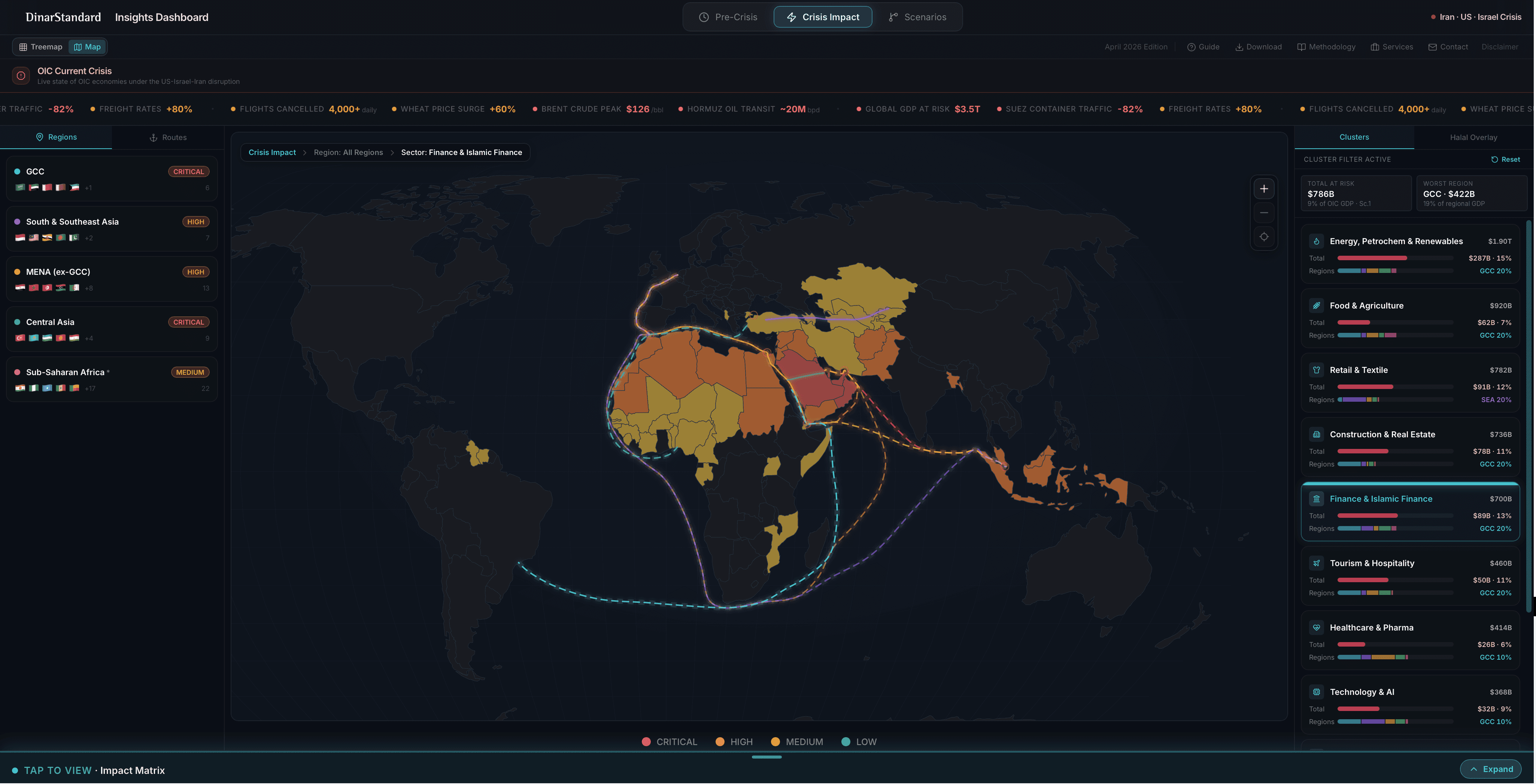
The interactive dashboard covers the Food & Agriculture crisis impact in full — chapter-level treemap, regional exposure, Direct vs Domino matrix, and scenario-linked strategic options.