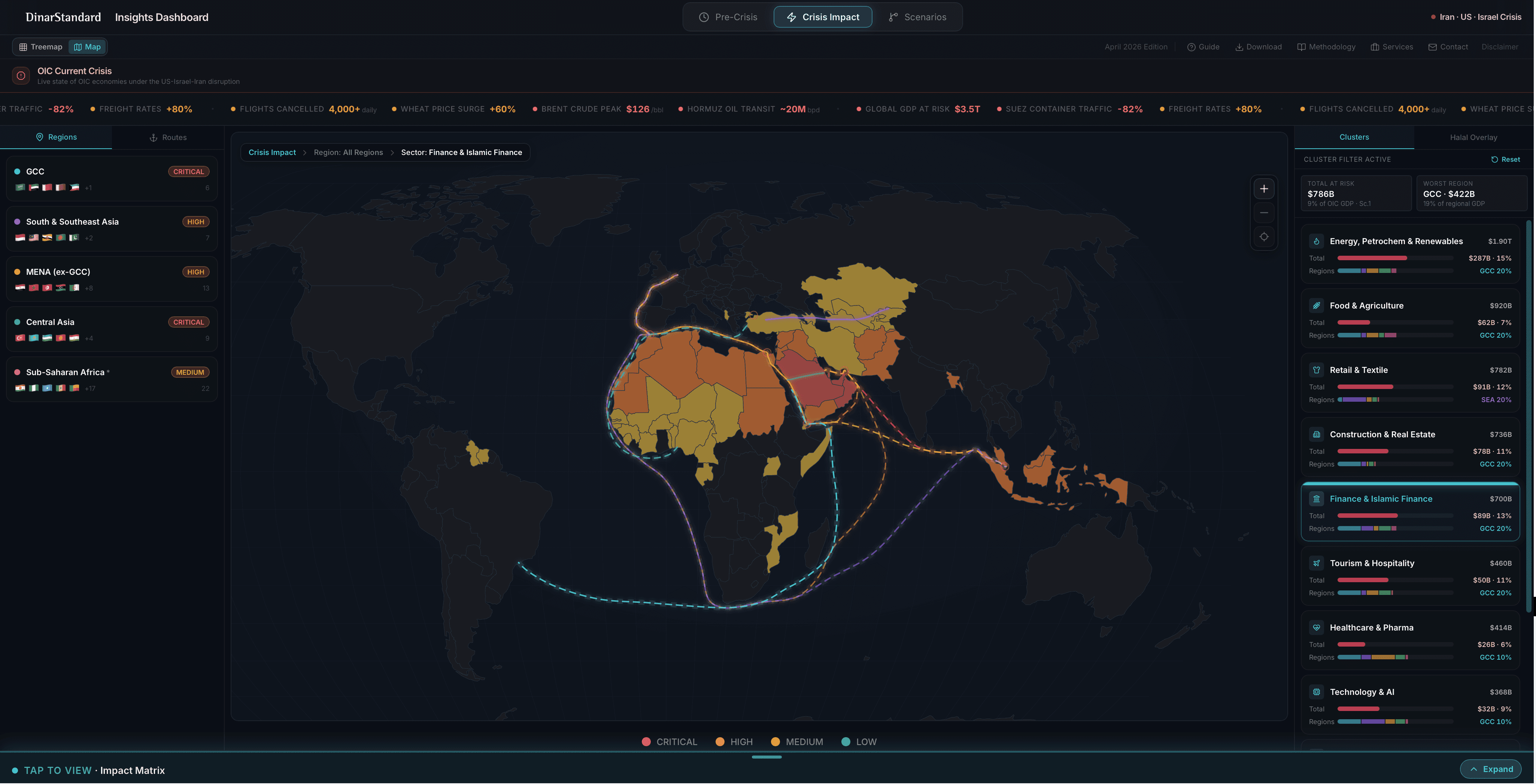
The February 2026 US-Israel-Iran regional crisis has triggered the largest energy supply disruption in modern history, with major implications for trade, investment, supply chains, and economic stability across OIC countries. DinarStandard’s latest Insights Brief examines what this crisis means for the US$ 9.2 trillion OIC economy and identifies the strategic options that matter most over the medium and long term.
What the brief covers
The brief provides:
A high-level view of the OIC economic landscape across 57 member states
The immediate crisis impact across energy, trade, food, finance, and social vulnerability
Scenario analysis to help assess how the crisis may evolve
Strategic positioning options for OIC governments and corporates over the next 1–2 years and 3–5 years
Regional implications across the GCC, South and Southeast Asia, MENA, Central Asia, and Sub-Saharan Africa
Why this matters
The brief argues that while many governments are rightly focused on immediate crisis response, the bigger question is what comes next. This crisis is not only a short-term disruption. It is also a structural turning point that could reshape trade flows, regional partnerships, fiscal priorities, and investment decisions across OIC markets for years to come.
Key findings
Pre-crisis baseline — The OIC entered 2026 as a $9.2T economy controlling 66% of global oil reserves and a $2.43T Halal economy growing at 8.3% CAGR. Strengths in energy, retail & textile, and fast-growing tech were offset by 28 food-deficit nations and $83B in fragile GCC-dependent remittances.
Overall crisis impact — Brent surging from $70 to $126/bbl and 70%+ of trade corridors disrupted delivered a simultaneous shock to energy, food, finance, and remittance systems. The OIC's $110B food import gap and $250–330B tech import dependency amplified vulnerability across non-energy member states.
Regional impact themes — The GCC gained a revenue windfall but faced 99% desalination dependency as an existential risk; MENA bore compound pressure via Suez disruption and $32B of Egyptian remittances at risk; South & SE Asia was hit through remittances and textile supply chains; Türkiye managed 3.6M refugees; and Sub-Saharan Africa faced acute exposure to the +60% wheat price surge.
Four scenarios — Outcomes range from Scenario 1 (ceasefire, oil at $85–100/bbl, routes reopening in 6–12 months) through Scenario 2 (Iranian exports disrupted by 1.5–2M bpd) to Scenario 3 (Hormuz restricted, GCC GDP –8 to –14%, $3.5T global GDP at risk).
Scenario 1 strategic option themes — The ceasefire window opens six macro priorities: energy transition, food security (tackling the 28-nation deficit), trade corridor redesign, digital acceleration (Tech & AI toward 6.5% of GDP by 2030), Islamic finance deployment ($5.98T asset base), and reducing the $80–100B defence import dependency.
Scenario 1 regional strategic themes — The GCC reinvests windfall revenues into diversification; MENA rebuilds Suez and renewable exports; South & SE Asia re-anchors the $782B Retail & Textile cluster and halal economy leadership; Türkiye activates the Middle Corridor and its $5.5B+ defence export platform; Sub-Saharan Africa builds food buffers and digital infrastructure for long-run resilience.
Scenario outlook
The brief outlines four possible scenarios, with Scenario 1: Ceasefire / New Normal used as the main basis for strategic planning. Even under this more moderate path, the report argues that the old equilibrium is unlikely to return. Instead, OIC countries may face a more multipolar environment marked by persistent risk premiums, shifting trade routes, stronger interest in intra-OIC collaboration, and growing urgency around food sovereignty, technology resilience, and Islamic finance infrastructure.
Strategic positioning themes
Under the primary planning scenario, the brief highlights ten areas where OIC countries can strengthen resilience and capture opportunity, including:
Energy transition and sovereignty
Islamic finance infrastructure
Food and agricultural sovereignty
Tourism and aviation resilience
Halal economy buildout
Supply chain diversification
Tech sovereignty and AI readiness
Defense industry localization
Intra-OIC trade acceleration
Human capital and workforce strategy
Explore the dashboard and download the full brief
The interactive dashboard provides a more dynamic view of the crisis, including regional exposure, sectoral implications, and scenario framing. Visit the dashboard to explore the analysis and download the full brief.
