The February 2026 US-Israel-Iran regional crisis has affected the financial system. Islamic finance is a $5.98 trillion industry, and because most of its cross-border flows still run on global dollar rails, the shock reaches it through two distinct channels, with the deeper effects set to persist beyond any ceasefire. Building on the April 2026 macro edition that mapped 11 OIC industry clusters and the May 2026 Food & Agriculture deep-dive, DinarStandard's June 2026 Insights Brief turns to Islamic Finance, banking, sukuk, funds, takaful, the financial rails, and de-dollarisation, examining how the crisis flows through each segment across OIC markets.
What the brief covers
The brief provides:
A sector profile of the OIC Islamic finance industry, four segments worth $5.98T in 2024, plus the rails, enablers, and a fast-growing fintech layer
Analysis of two impact channels: Systematic (prices and yields that move in weeks) and Systemic (balance-sheet stress that builds over years)
A four-segment transmission chain showing how the closure of the Strait of Hormuz flows into banking, sukuk, funds, and takaful
A June 2026 pulse check on the crisis trajectory across three scenarios, with the 14-15 June US-Iran deal to reopen the Strait
Eight strategic positioning options for OIC governments and corporates over the next 1-5 years
Regional strategic themes across the GCC, West Asia, North Africa, South & Southeast Asia, Sub-Saharan Africa, and Central Asia
Why this matters
Islamic finance is highly concentrated and structurally dollar-linked. Three countries, Iran, Saudi Arabia, and Malaysia, hold 72 percent of global assets, and in 17 jurisdictions Islamic banking is more than 15 percent of the domestic system, which means an Islamic-finance shock could spill over to conventional financial market or vice versa. Because settlement and funding still run on dollar rails, and the currency pegs pass the shock straight through, the exposure is both immediate and structural. Through the systemic channel, today's pressure on bank margins, sukuk refinancing, and sovereign balance sheets are already shaping the 2027-29 outlook.
Key findings
Sector scale
The industry reached $5.98T in 2024: Islamic banking at $4.32T (72 percent of assets), sukuk at $1.03T outstanding, Islamic funds at $308B, and takaful at $136B. A digital layer of $198B in Islamic fintech, about 1.5 percent of the $12.9 trillion conventional fintech market, is growing 11.5 percent a year toward $341B by 2029.
Two impact channels.
Systematic impacts arrived in weeks: GCC dollar sukuk yields hit five-year highs, the Tadawul fell about 12 percent and Dubai about 17 percent in week one, and marine war-risk cover jumped from 0.125 toward 0.4 percent of ship value. Systemic impacts build over years: weaker bank asset quality, a sukuk refinancing wall meeting rising sovereign supply, and sovereign wealth funds drawing down to cover deficits.
Where the damage concentrated.
At the peak of the crisis, total sukuk issuance fell about 47 percent, but almost all of it hit the dollar market, with almost benchmark dollar prints in the weeks of 7 and 14 March. Local-currency markets in Malaysia, Indonesia, and Türkiye stayed open and recovered to within about 12 percent of their pre-war pace.
Though IILM short-term sukuk auctions stayed more than twice oversubscribed, a clear flight to quality due to its HQLA treatment.
The screening question.
Sharia screening protected investors against a broad global index (the DJ Islamic Market World fell 9.5 percent versus 10.5 percent, with lower volatility and a higher Sharpe ratio). Though this was not the case for the tech-heavy S&P 500 (the Shariah version fell 10.9 percent versus 9.1 percent), because screening out leveraged financials concentrates it into mega-cap technology.
June 2026 pulse check.
Brent jumped from $71.3 to $77.2 in two trading days after the 28 February strikes, before easing about 20 percent from its peak by May. On 14-15 June the US and Iran announced a deal to reopen the Strait and extend the ceasefire, to be signed 19 June, though late-June strikes showed how fragile the path remains.
Scenario outlook
The brief tracks three scenarios, with Scenario 1 (New Normal, ceasefire holds) as the primary planning basis. As of June 2026, the 14-15 June deal points the trajectory back toward Scenario 1, but renewed strikes and stalled talks keep Scenario 2 (Civil Unrest) in play. Whichever way the trigger settles, the systemic effects on balance sheets may persist for some time to come.
Strategic positioning themes
Under the primary planning scenario, the brief identifies eight options across four strategic levers: Settlement Sovereignty, Resilient Capital Markets, Risk Pooling, and Intra-OIC Integration:
De-dollarised settlement
OIC payment union / Islamic CBDC
Crisis-resilient & liquidity sukuk:
Intra-OIC capital-market integration
Re-takaful war-risk pool
Islamic liquidity-management infrastructure
Islamic social-finance buffer
Agri-finance link (connected to Brief #2)
Explore the dashboard and download the full brief
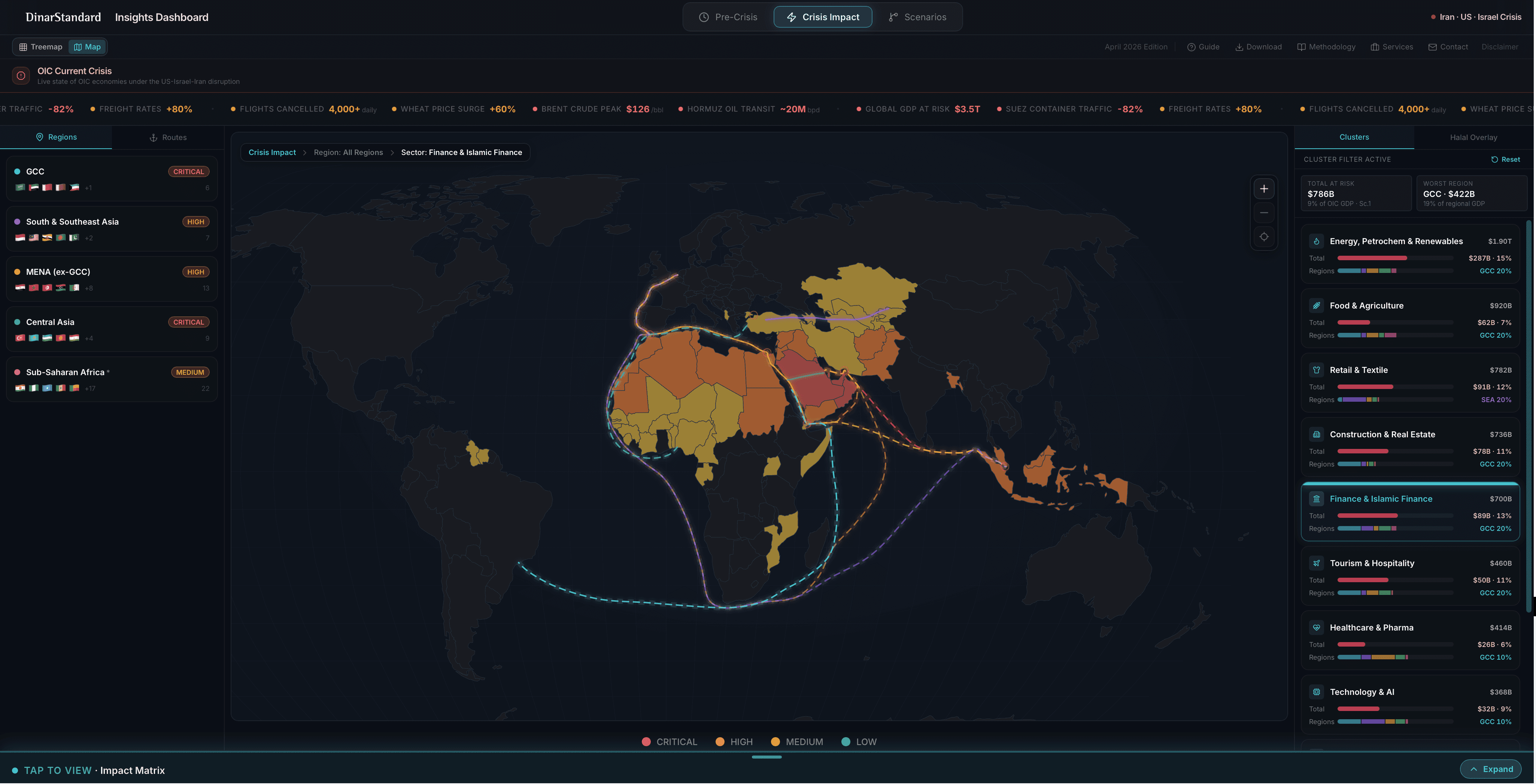
The interactive dashboard covers the Islamic finance crisis impact in full: a pre-crisis treemap by segment, regional exposure across the OIC, the systematic-versus-systemic view, and scenario-linked strategic options you can filter by region.
