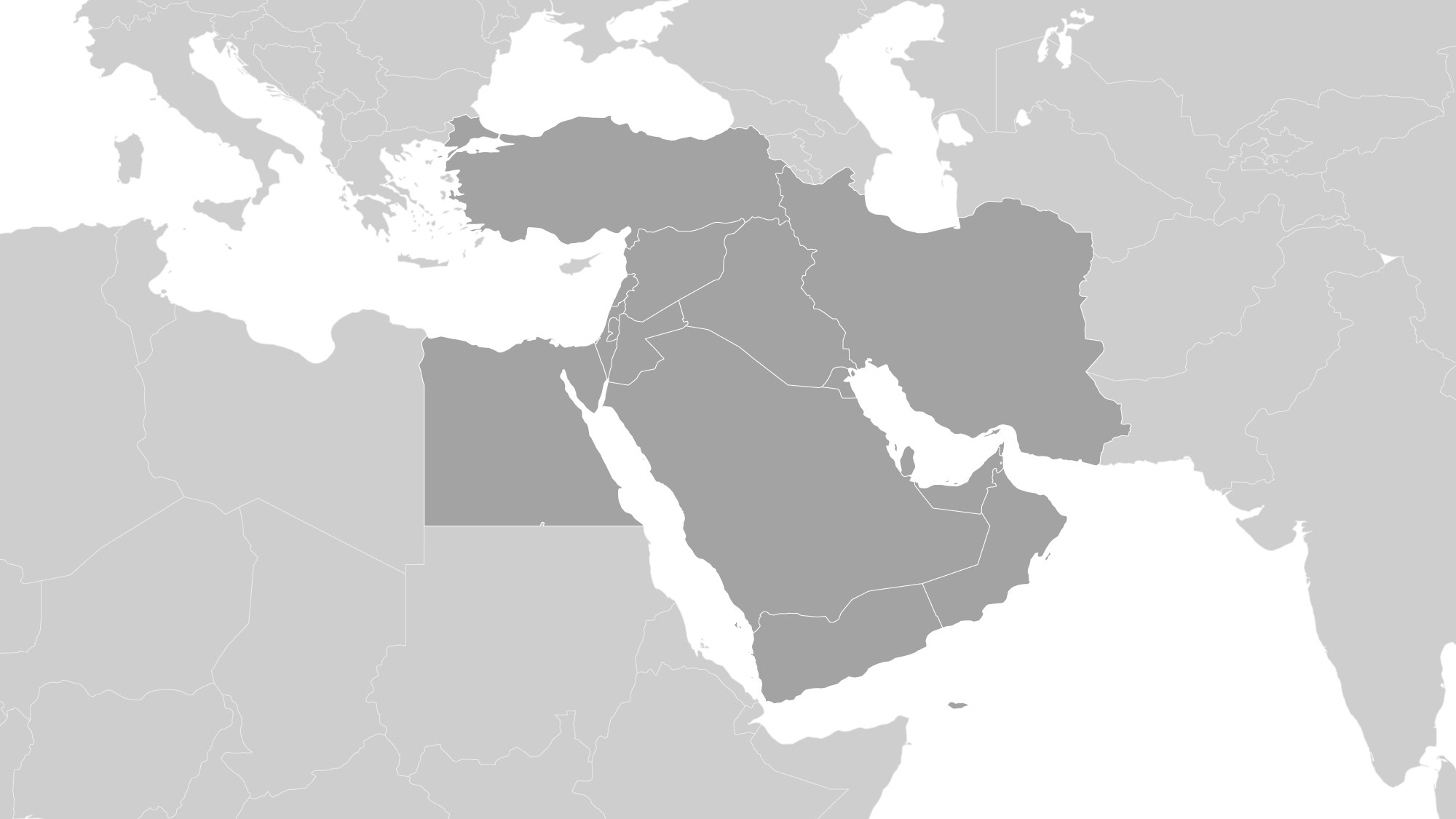
The February 2026 US-Israel-Iran regional crisis has created the largest energy supply disruption in modern history — surpassing the 1973 oil embargo in scale and cascading impact. DinarStandard's inaugural Insights Brief examines the economic implications for the $9.2 trillion OIC economy and identifies strategic positioning options that can convert this disruption into lasting structural advantage.
The Core Thesis
Governments across OIC member states are actively managing immediate crisis response using frameworks refined through COVID-19, Ukraine-Russia, and Suez disruptions — and those short-term responses are appropriate. However, medium- and long-term strategic challenges remain largely unaddressed. OIC countries that shift from crisis management to proactive repositioning now will be best placed to shape the multipolar trade, finance, and defense realignment that is already underway.
The Immediate Economic Crisis
Energy is the primary shock driver, with cascading effects across four key vectors:
Four Crisis Scenarios
The brief models four potential paths, with Scenario 1 selected as the primary basis for strategic planning based on current diplomatic signals and partial Hormuz convoy resumption.
Scenario 1
Ceasefire / New Normal (Primary Planning Basis)
Ceasefire and multipolar realignment. Oil stabilizes at $90–100/bbl. Intra-OIC trade corridors strengthen. GCC-US alliance loosens; Türkiye emerges as NATO-OIC bridge. De-dollarization accelerates via CIPS and mBridge.
Scenario 2
Civil Unrest in Iran
Internal Iranian fracture creates Syria-like instability. Extended energy volatility over 6–12 months. Refugee flows increase pressure on Türkiye and Pakistan. Humanitarian spillover crowds out economic development capital.
Scenario 3A
Protracted War (Iranian Resistance Escalates)
Full-scale war of attrition. GCC GDP contraction of 8–14% (Goldman Sachs). Mass capital flight. Food crisis deepens. OIC splits between US-aligned and Russia-China blocs.
Scenario 3B
Protracted War (Compounded by Civil Unrest)
Worst-case humanitarian and fiscal outcomes. Extended Hormuz closure. SWF liquidation to cover deficits. Up to 6M+ displaced refugees. 80M+ food insecure across OIC.
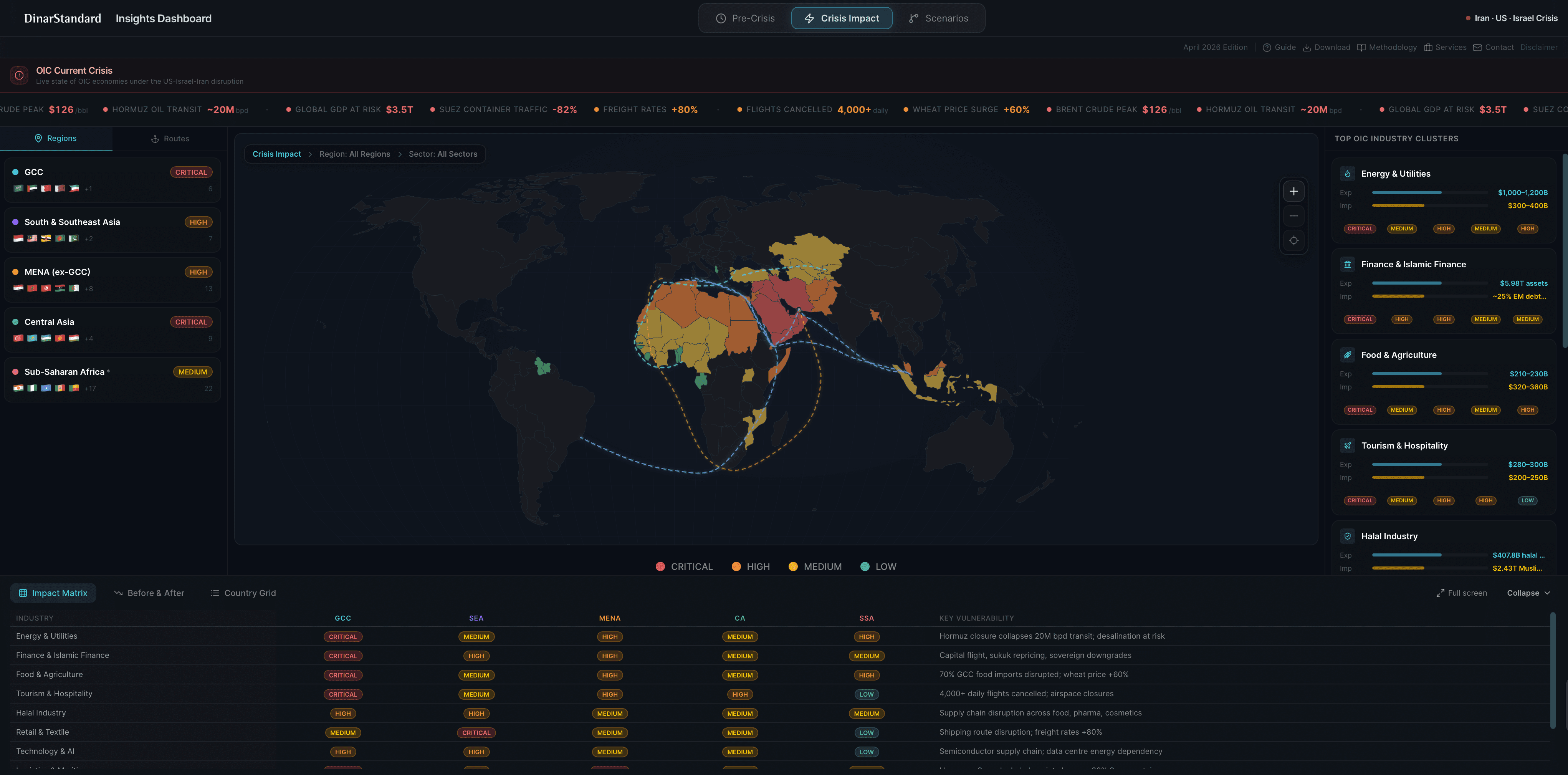
What the Brief Covers
OIC socio-economic profile across 57 member states and 10 industry clusters
Immediate crisis impact assessment across energy, food, trade, finance, and social dimensions
Dual Hormuz–Suez chokehold geography and regional impact matrix
Scenario modelling and trigger indicators for real-time calibration
Lessons from COVID-19, Ukraine-Russia, and Suez disruptions
10 strategic positioning areas for medium-term (1–2 year) and long-term (3–5 year) planning
Regional positioning roadmaps across GCC, South & SE Asia, MENA, Central Asia, and Sub-Saharan Africa
Actionable guidance for OIC government agencies and corporate leaders
10 Strategic Positioning Areas - Scenario 1: New Normal
Theme
Medium-Term (1–2 yrs)
Long-Term (3–5 yrs)
Energy Transition & Sovereignty
Renewable scale-up; pipeline bypass activation; strategic reserves
Green hydrogen hubs; OIC energy grid interconnection
Islamic Finance Infrastructure
CIPS/mBridge for OIC settlement; war-resilient sukuk issuance
OIC payment union; Islamic CBDC network
Food & Agricultural Sovereignty
Emergency grain reserves via IOFS; Indonesia-GCC food corridor
OIC agricultural self-sufficiency; Africa as food hub
Tourism & Aviation Resilience
Türkiye, Morocco, Indonesia capture redirected demand
OIC open-skies agreement; Gulf hospitality recovery
Halal Economy Buildout
Harmonize certification via SMIIC (30–50% cost reduction)
OIC countries in top halal exporters; $608B import market capture
Supply Chain Diversification
China+1 textile share capture; EU nearshoring via Morocco/Tunisia
OIC cotton-to-retail value chain
Tech Sovereignty & AI Readiness
Sovereign cloud/AI in GCC; Malaysia as semiconductor hub
OIC-AI corridor; $320B AI GDP contribution by 2030
Defense Industry Localization
Türkiye-Pakistan-GCC procurement corridor; joint drone R&D
Indigenous OIC manufacturing; 50% Saudi localization
Intra-OIC Trade Acceleration
Activate TPS-OIC (37 states); scale Duqm/East Africa corridors
OIC common market; integrated logistics network
Human Capital & Workforce Strategy
Modular construction; material sourcing from Türkiye/North Africa
OIC materials value chain; talent mobility programs
Methodology
The brief is informed by DinarStandard's proprietary Innovation Megatrends Framework, adapted for OIC crisis scenario analysis. It draws on secondary research from trusted global sources — IMF, World Bank, IEA, WTO, FAO, Goldman Sachs, Oxford Economics, Lloyd's of London, SIPRI, and UNCTAD — as well as primary validation from senior economists at the Islamic Development Bank, Bank Indonesia, ICDT, and DinarStandard's global partner network. AI tools assisted with data synthesis and scenario modelling support; all outputs were reviewed and validated by DinarStandard's senior analysts.

About This Insights Brief Series
This is the first in a series of Insights Briefs examining the OIC economic outlook amid the 2026 regional crisis. Subsequent briefs will provide sector and country-level deep dives tied to a series of roundtables for OIC government agencies, policymakers, and corporate leaders.