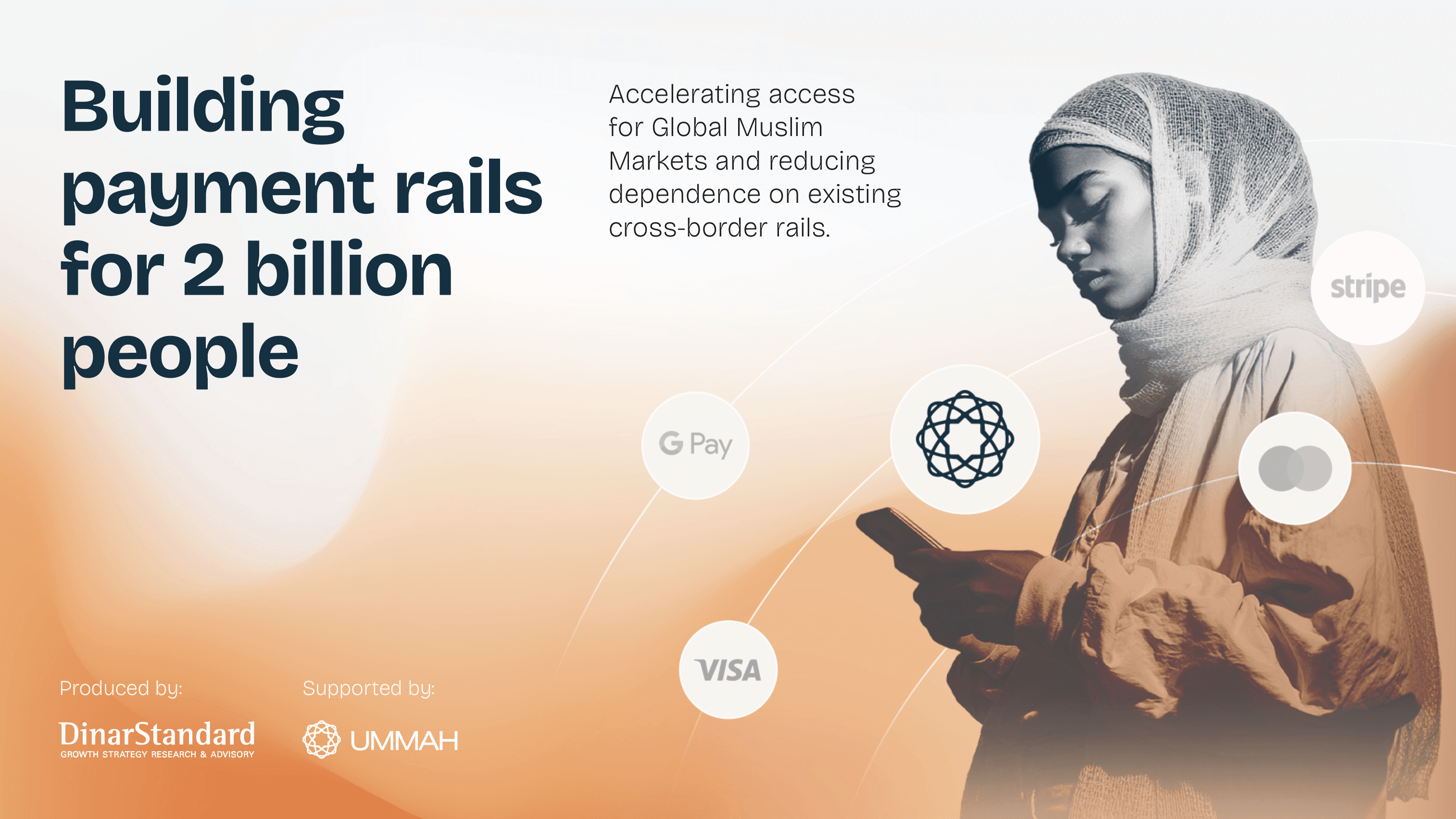
The Banking for the Debanked: Building Financial Rails for the Excluded 2 Billion Strategy Brief examines the infrastructure gap at the heart of the global Islamic economy. Produced by DinarStandard and supported by Ummah, this brief maps the highest-impact opportunities — Islamic philanthropy, remittances, and SME trade payments, and outlines a phased approach to building shared, interoperable payment rails that lower costs, widen access, and strengthen financial sovereignty across Muslim-majority markets.
Key Insights:
Build shared, interoperable payment rails for Muslim markets — starting with high-impact corridors — to lower cost and delay, widen access, and strengthen financial sovereignty.
The scale and momentum of the global Islamic economy are growing, with US$2.43 trillion in global Muslim consumer spending (2023) and intra-OIC exports reaching US$491 billion (2024).
- Despite this growth, cross-border payments still face core gaps in access, cost, speed, and transparency.Mapping analysis suggests prioritizing use cases that combine impact and feasibility, where cross-border Islamic philanthropy, remittances, and trade payments emerge as three key opportunities.
Build in phases with clear governance, starting with core infrastructure and evolving into a full financial operating system (Payments → Banking → Investment): Start by launching core infrastructure, then implement multi-acquirer orchestration, ultimately owning the payment rails.
Why Now?
The scale and momentum of the global Islamic economy are growing, with US$2.43 trillion in global Muslim consumer spending (2023) and intra-OIC exports reaching US$491 billion (2024).
As finance becomes the lifeblood of the economy, improving cross-border payments directly supports intra-OIC trade and overall economic growth. At the same time, global trends are reducing intermediaries, making payments more direct across domestic, regional, and global transactions.
What’s Broken?
Despite this growth, cross-border payments still face core gaps in access, cost, speed, and transparency. Many remain excluded—2.9 billion people globally still lack access to digital ID systems that enable online transactions (2024), and five OIC countries are classified as grey- or high-risk in the global financial system. In terms of cost, 24.1% of payment corridors have average fees above 3% (2024). Speed is also an issue, with average cross-border payment times exceeding one business day, increasing by 5.1% (2023–2024). Transparency remains limited: 43% of providers do not disclose fees upfront, meaning users often do not know the final fee, FX rate, or payment status until the transaction is completed.
Another key issue is Apple’s in-app payment monopoly, which has inflated prices. A decade of platform control has limited payment choices and enabled high App Store commissions. Apple’s 15–30% commission and mandatory payment routing gave it direct control over pricing, with little competitive pressure.
Regulatory pressure is now forcing change. Following the Epic Games v. Apple ruling, Apple has been required to revise its US App Store guidelines. The changes are significant: External checkout links are now permitted, zero Apple commission on external purchases, removal of restrictive “scare screens” and Improved price transparency for users
Where to Play?
Mapping analysis suggests prioritizing use cases that combine impact and feasibility, where cross-border Islamic philanthropy, remittances, and trade payments emerge as three key opportunities:
Start first: US$1.1B market – Humanitarian & giving
Transparent disbursement to beneficiaries; a clear low-hanging opportunity
Scale next: US$215B market – Remittances
High-frequency, high-value flows to households across major emerging corridors; strong impact on growing Muslim economies
Long term: US$494B market – SME trade payments
High impact, reduces friction in intra-OIC commerce, and enables deeper economic integration and resilience for SMEs
How to Win?
Build in phases with clear governance, starting with core infrastructure and evolving into a full financial operating system (Payments → Banking → Investment): Start by launching core infrastructure, then implement multi-acquirer orchestration, ultimately owning the payment rails.
