When the conversation turns to the global halal economy, Korea is rarely named among the main players. Yet the country has quietly built a significant footprint — a substantial trade relationship with member states of the Organisation of Islamic Cooperation (OIC), and a wave of cultural exports carried into Muslim markets on the back of Hallyu, the Korean Wave. Together, these have opened a door to far deeper expansion into one of the world's fastest-growing consumer markets.
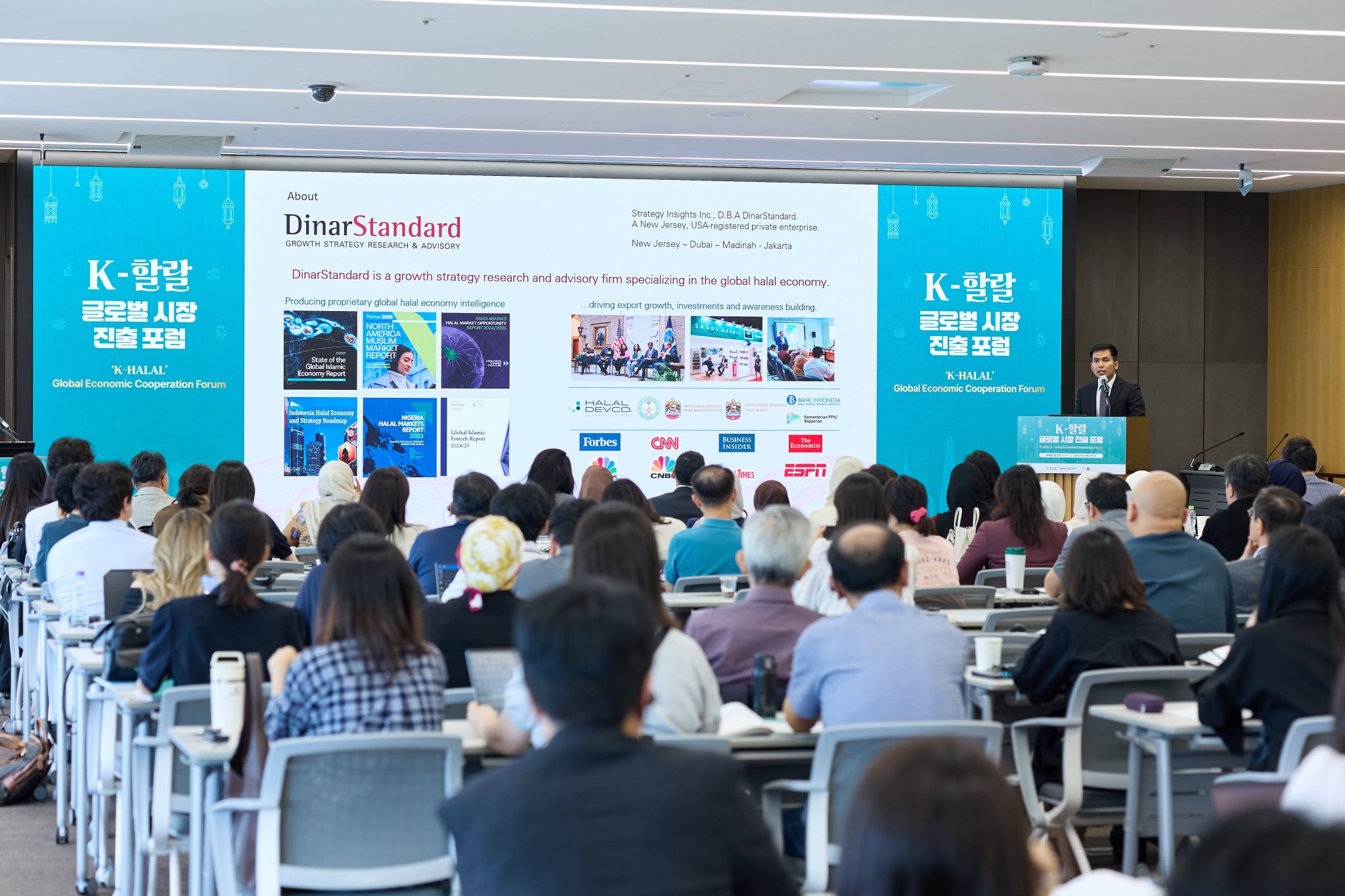
That was the central message of a presentation delivered by DinarStandard at the K-Halal Global Economic Cooperation Forum on 27 August 2026 at the Trade Tower in Seoul. Organised by the Korea International Trade Association (KITA), the forum drew 140 participants, including H.E. Jamal Abdulla Al-Suwaidi, Ambassador of the UAE to the Republic of Korea, and a delegation from the Sharjah Business Women Council, alongside more than 100 Korean companies spanning K-Food, cosmetics, and healthcare.
The discussion made a simple but under-appreciated case: Korea is not starting from zero in the halal economy. It is starting from a position of quiet strength — and the window to build on it is open now.
Korea's footprint is real, not hypothetical
According to DinarStandard’s State of the Global Islamic Economy report, Muslim consumers spent around US$2.6 trillion across six real-economy sectors in 2024 — food, pharmaceuticals, cosmetics, modest fashion, travel, and media. This is projected to reach US$3.56 trillion by 2029, while OIC countries imported around US$421.5 billion in halal-related goods in 2024. The field is open, and quality-driven newcomers can win market share.
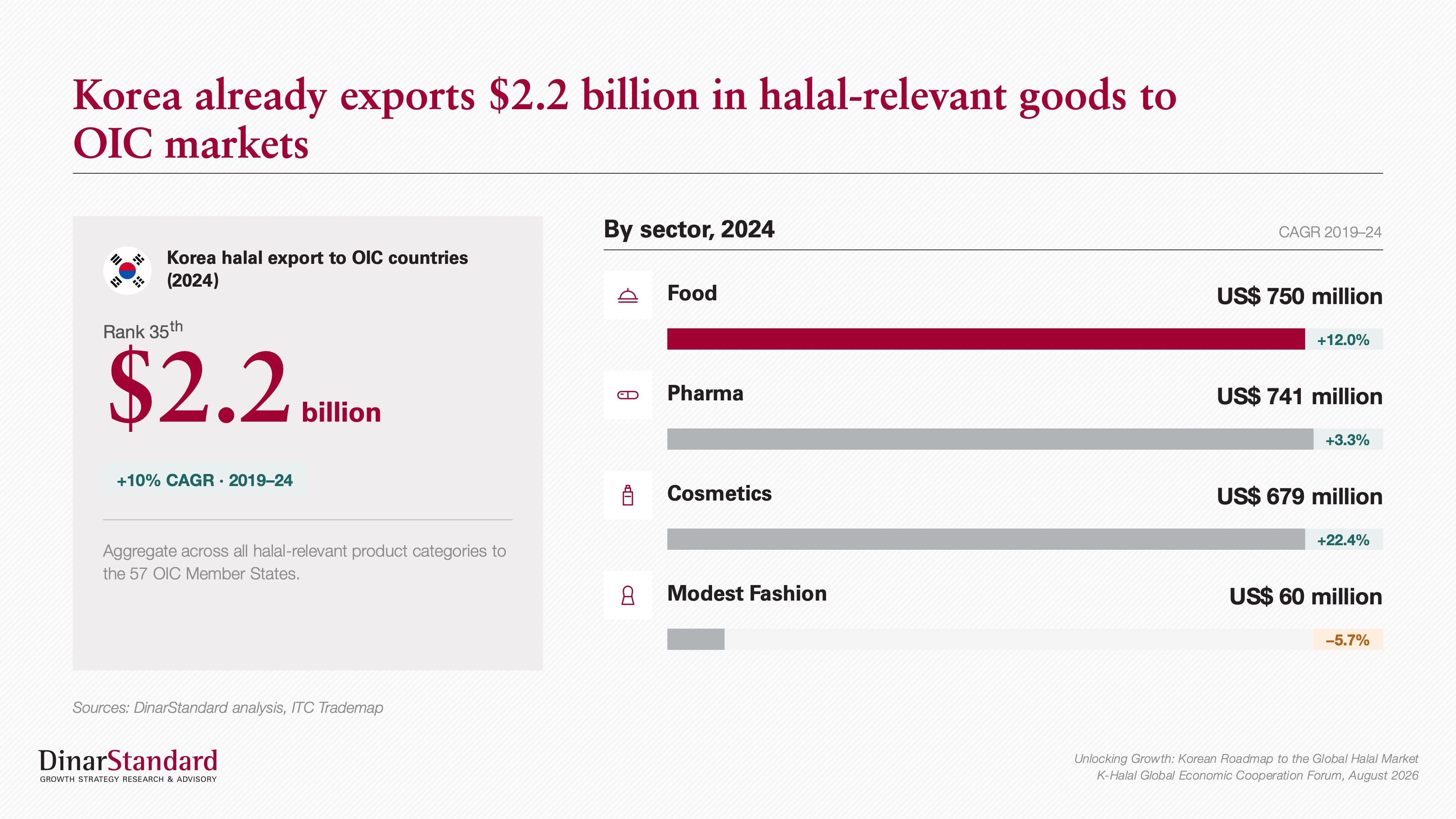
This makes Korea’s position particularly interesting. The country already exports around US$2.2 billion in halal-relevant goods to OIC markets, with exports growing at a compound annual rate of 10% between 2019 and 2024. Korea currently ranks 35th among exporters to the OIC. Korea has a meaningful presence, but remains well below its industrial potential.
The sector-level picture makes the opportunity clearer. Korean cosmetics exports to OIC markets have grown 22.4% annually (2019-2024) while food and pharmaceuticals have also posted solid growth. Looking at the latest trade data by product category, cosmetics stands out for being both among Korea’s largest halal-relevant exports and its fastest-growing. A product that is already at scale and still accelerating is the clearest signal of where to focus.
The cultural engine behind the numbers

Behind these figures is an advantage few competitors can easily replicate: cultural affinity. The global spread of K-content — Korean dramas, K-pop, and K-beauty — has created strong familiarity with, and demand for, Korean products across Muslim-majority markets.
Korean cultural content has a leading share of cultural viewing in key markets, and that exposure is translating into consumption. Surveys of consumers who have tried Korean food show favourability of around 80% in Indonesia and 79% in Malaysia, with a meaningful share saying they were specifically drawn to it because they wanted to experience the food culture they had seen on screen.
In cosmetics, the story moves from culture to capability. Consumers across the Gulf and Southeast Asia rate Korean beauty products highly, with the UAE ranking highest, and importantly, they choose them for qualityrather than simply following trends. That distinction matters. It points to a strong and defensible advantage in Korea’s world-class cosmetics value chain, manufacturing and R&D capabilities, and ability to bring new formulations to market faster than most competitors. Culture opens the door; quality keeps consumers coming back.
From opportunity to entry: a product-first path
Recognising the opportunity is one thing; acting on it is another. The forum’s practical framework was deliberately product-first, built for companies that already make things. It starts with where to play, encouraging companies to build on the products they already export well and identify where demand is accelerating. The value-chain logic also differs by sector. In pharmaceuticals, Korea’s R&D strength makes it a natural supplier of ingredients as OIC countries build their own production capacity. In food and cosmetics, where quality and brand equity are decisive, companies should keep manufacturing and branding in-house.
The next question is how to enter. Market entry is a sequence of gates covering eligibility, halal certification, trade agreements, entry mode, and launch. The key rule is that each market recognises its own certifiers, so compliance needs to be planned market by market. Finally, how to win matters as much as getting in. Getting onto the shelf is not the same as staying there, and durable success depends on three levers working together. Marketing turns cultural affinity into loyalty, investment moves real trade volume through joint ventures and regional hubs, and R&D builds products halal-by-design.
The window is open
Korea’s trade links with its two anchor corridors — the Gulf, through the UAE, and Southeast Asia, through Indonesia — are strengthening just as halal-certification recognition is expanding and cultural demand for Korean products is rising.
In the Gulf, the UAE–Korea CEPA entered into force in May 2026, marking Korea’s first CEPA in MENA, while the GCC–Korea FTA was signed in June 2026, creating a broader bloc-wide framework. In Indonesia, Korea already benefits from the ASEAN–Korea FTA and RCEP framework, alongside the Indonesia–Korea CEPA, in force since 2023. At the same time, BPJPH had recognised six Korean halal certification bodies by August 2026, helping create a clearer path for Korean products to obtain halal certification for the Indonesian market. Trade access is improving and the rails for halal trade are being laid at the same time.
The demand is proven, the cultural door is open, and the path is becoming more practical. For Korean industry, the question is no longer whether to enter the global halal market — but which product, and which market, first.