
This presentation makes the case for US and Canadian food companies to enter the global halal food market, walking through the size of the opportunity, the regulatory landscape that governs access, and a practical framework for evaluating and entering priority markets. It closes with an overview of DinarStandard's advisory support for companies pursuing this path.
Section 1: Global Halal Food Market Overview
Market size: The global halal economy represents $2.6T in consumer spending by 2 billion Muslims across six sectors, growing 7% YoY toward $3.56T by 2029 (6.5% CAGR). Halal food is the largest sector: $1,525B → $2,058B (6.2% CAGR).
Drivers: Supply-side (government enablers, national strategies, global brand entry, trade agreements) and demand-side (young/affluent Muslim population growth, digital commerce, values-driven consumption).
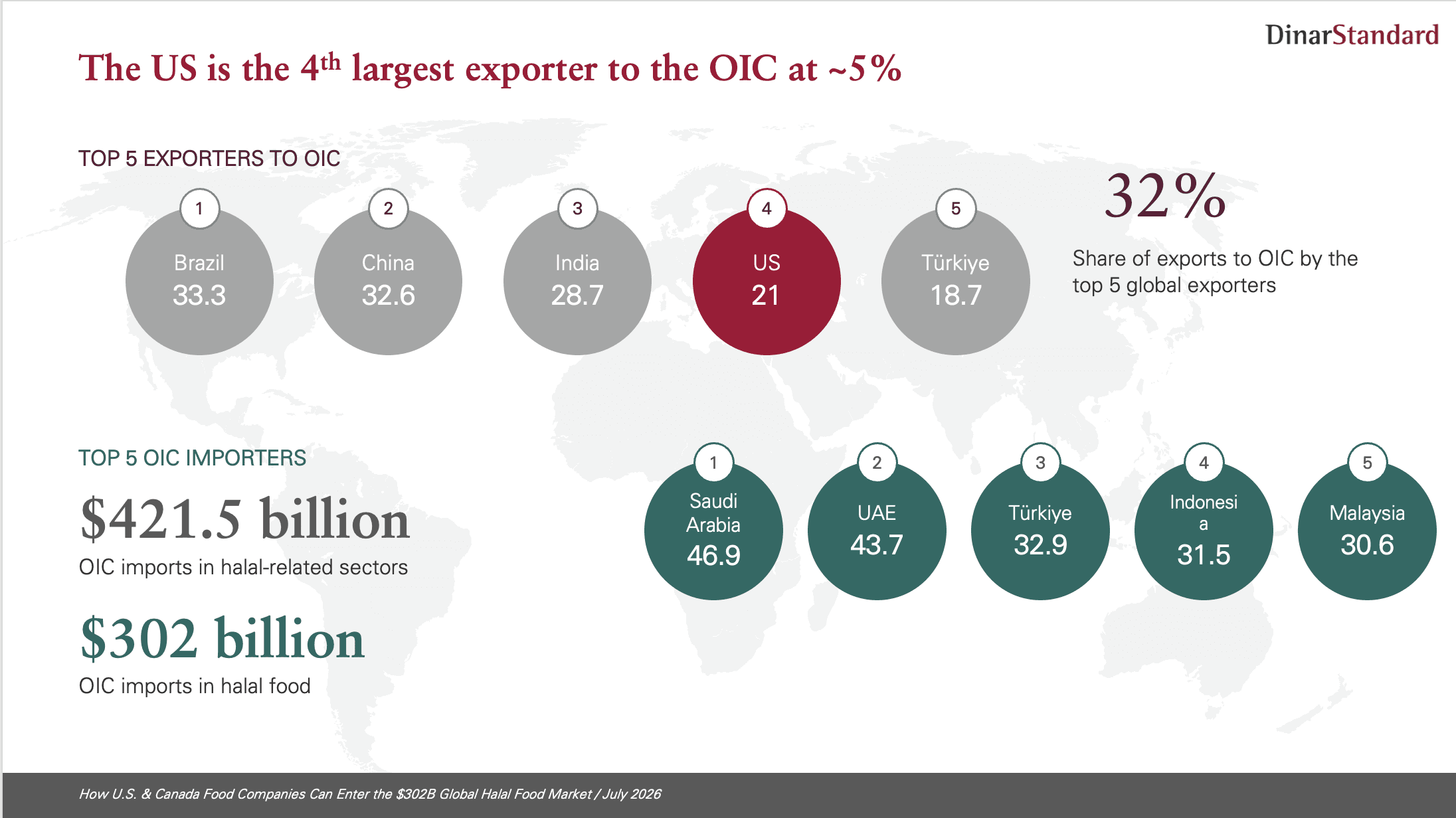
US position: The US is the 4th-largest exporter to the OIC (~$21B, 5% share), behind Brazil, China, and India. Top OIC importers are Saudi Arabia ($46.9B), UAE, Türkiye, Indonesia, and Malaysia; total OIC halal food imports are $302B.
Competitive dynamics: Tailwinds (export rank, strong food/pharma base, resilience) offset by headwinds (fragmented compliance costs, OIC nearshoring, self-sufficiency push).
Existing/best pathways: US/Canada already export soyabeans, nuts, wheat, and legumes to Indonesia, UAE, Saudi Arabia, Türkiye, Malaysia, Bangladesh, and Algeria. Fastest-growing import categories are fats & oils (8.17% CAGR), sugars & confectionery (8.51%), and beverages & vinegar (6.15%) — with Türkiye, Malaysia, Saudi Arabia, UAE, and Indonesia recurring as top buyers across all three.
Section 2: Navigating the Regulatory Maze
Halal certification is a 4-layer ecosystem: Regulatory Body (legal framework) → Standard Body (technical standards) → Accreditation Body (licenses certifiers) → Halal Certification Body/HCB (audits & certifies), with roles sometimes overlapping within one country.
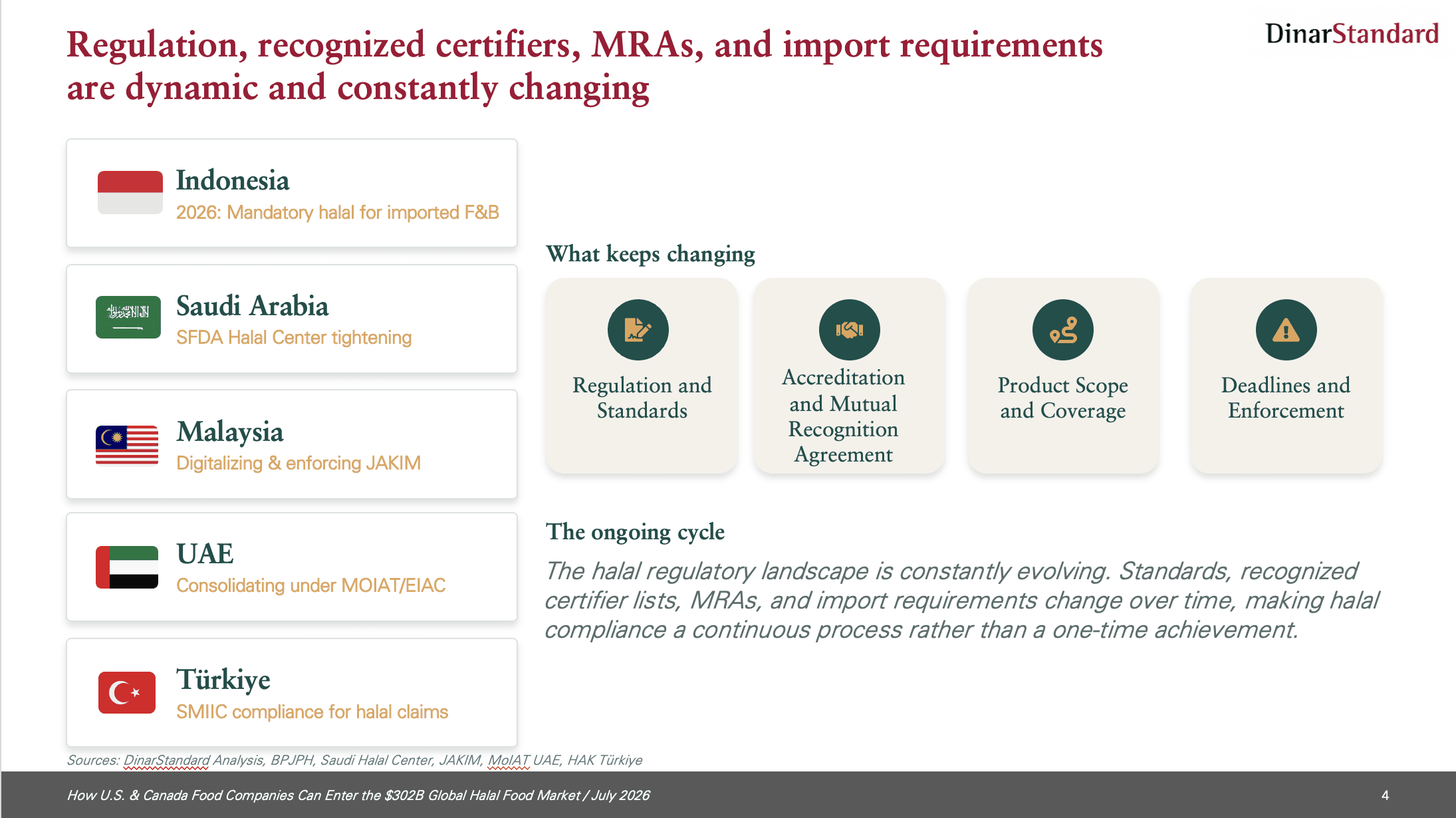
Country-specific authorities: Indonesia (BPJPH), UAE (MoIAT), Saudi Arabia (SFDA/Saudi Halal Center), Türkiye (HAK), Malaysia (JAKIM) — each keeps its own approved list of recognized foreign certifiers.
Two compliance pathways: (1) Certify locally via a recognized US/Canada HCB already on a destination’s list (recognition can be scope-specific); (2) certify directly under the destination’s national scheme (longer lead times, repeat audits/cost).
US–Indonesia trade agreement: Addresses halal terms (US slaughter acceptance, MRA on certifier efficiency) but remains unratified as of June 2026; halal stays mandatory regardless. Flagged as a top concern in USTR’s 2025 Report for Saudi Arabia, UAE, Indonesia, and Malaysia.
Constant change: Regulations, MRAs, and enforcement deadlines shift continuously (e.g., Indonesia’s mandatory halal for imported F&B takes effect in 2026) — compliance is ongoing, not a one-time achievement.
Section 3: Go-to-Market Considerations
Three-step framework for entering an OIC market:
Confirm you can export — check for bans (US poultry banned in Türkiye over avian flu; pork/alcohol restrictions), tariffs (0%–40%+), and permits (Indonesia dairy 5–10% + BPOM; Malaysia frozen chicken up to 40% non-ASEAN; GCC 5% tariff + 5% VAT; Türkiye ~42% agri tariff vs. EU’s duty-free access).
Understand local opportunity context — Indonesia/Malaysia: 280M+ Muslims, e-commerce-led, local flavors and Bahasa labeling; GCC: wealthy/import-reliant, chilled chicken leads, Ramadan peaks, one spec fits six states; Türkiye: 86M young middle class, best fit is ingredients/nuts/confectionery, halal assumed not a differentiator.
Meet compliance requirements — Indonesia mandates halal from 17 Oct 2026 (BPJPH, no mark transfer); Malaysia requires JAKIM-recognized certifiers (MS 1500:2019, pork-free facilities); GCC requires GSO 993 slaughter + UAE ESMA approval; Türkiye tracks EU pesticide/residue limits.
Section 4: DS Support and Advisory
DinarStandard offers two support tracks:
Halal Market Export Advisory — a proprietary 5-step export enablement process (4–6 weeks) covering market prioritization, entry assessment, and partner introductions, with regional partners Halal DEVCO (MENA) and Indonesia Halal Lifestyle Center (SE Asia);
HalalPath™ — a real-time intelligence platform covering 300+ certification bodies across 70+ countries, offering certification mapping, MRA pathway finder, trade-restriction pre-filtering, and real-time regulatory alerts.